Monday, January 7, 2013

This is what planning to protect agriculture looks like

For those interested in land use issues, I thought this picture along the Potomac River just north of Washington, D.C., was very telling.

 Photo compliments of the Montgomery Countryside Alliance


On the LEFT, Loudon County, Virginia, which has a very typical approach to growth and land-use in a formerly very agricultural area.

On the RIGHT, Montgomery County, Maryland, which created an agricultural preservation area encompassing a large swathe of the north half of the county.

This is what real agricultural land protection looks like and I applaud Montgomery County for their accomplishments.

Saturday, January 5, 2013

Pulled Pork


Recently, Will, Kent, & Paul had the pleasure of attending the ALBC conference in Raleigh, North Carolina. For those of you unfamiliar with ALBC, their mnemonic stands for American Livestock Breeding Conservancy. 

http://albc-usa.org/


Their purpose? To preserve and promote heritage breeds of American livestock, very much like the farm animal equivalent of heirloom tomatoes. Their yearly conference is chocked full of interesting conferences and workshops, but what most intrigued us was their boar semen collection and analysis workshop, held in conjunction with the University in Raleigh.

While we generally still prefer using a more natural impregnation system, i.e. our boars, there are circumstances where Artificial Insemination (AI) would be useful. One example would be breeding young gilts (females sows) to full-sized boars, who would normally injure the female because of their great size and weight.

Also, because the genetic pool for our Old Spot pigs is so limited in the U.S. (in the 70's it was estimated that only 200 Old Spot pigs existed worldwide!), the prospects of importing semen from England is very appealing. 


I have to admit that I was a little disappointed in the housing for the University's pigs. While I LOVED the slatted floors and roll up side walls of their building, great for cleanliness and air circulation, I was disappointed in their use of small stalls (which I have chosen not to show) and the fact that the hogs were never allowed out-of-doors on grass.

Some of the young gilts were held in larger group pens as shown above and below, which seemed much better, but this only representing a few of the animals on premises.


We started by familiarizing ourselves with some of the equipment used for semen collection, probably the most important of which is the dummy. 


Here we see our massive boar circling, slobbering, smelling and just generally stinking up his 'date'. Anyone who has a romantic notion of how livestock animals breed, will be sorely disappointed. There is usually very little romance or foreplay involved, and things can get very rough.

The boar mounts the dummy and, well, with some assistance from a helping 'hand', a sample is collected.
Alternatively, a female 'in heat' can be used to start the process and then the 'hand of man' (or woman) steps in and finishes the process.
Believe me...it can be very intimidating to be squatting next to these massive and powerful creatures!

We hope to start using AI on a more regular basis on our farm to assist in preserving and protecting our wonderful Old Spot hogs from extinction!

Sunday, December 16, 2012

INCINERATOR plans really burn me up!


Frderick County has been looking into a large-scale incinerator for the past 4 or 5 years and has been moving forward with those plans despite the astronomical price tag and loss of a partnership deal with neighboring Carroll County. 

Plans include receiving trash from neighboring counties to be burned, concentrating the negative environmental effects of not just our own, but others' trash, here in Frederick County.

Here is a letter to the editor Will wrote in regards to our county's plans to build an incinerator in Frederick County:

Most of the candidates running for local office are focused on the economy and growth issues. With unemployment high, commercial space sitting empty, and a stagnant real estate market, that is understandable. But, the reality is Frederick county is caught up in a national, and to some extent, global recession. There is little local politicians can do to jump start the national economy. The only real “local” issue in the upcoming election is whether or not the next board of County Commissioners proceeds with the planned $600 million dollar municipal solid waste incinerator. The single largest debt ever imposed on the citizens of Frederick County.

It only seems logical to see how existing municipal waster incinerators are doing. After all, the past is the best prediction of the future. In the last few weeks alone, 3 incinerators have made headlines. Harrisburg, PA’s incinerator is about to go into receivership because the city can no longer pay for it; Hudson Falls, NY is trying to sell their incinerator; and most troubling, Spokane, WA’s incinerator violated air pollution limits for mercury in June. Why did it take until September for the violation to surface? Apparently, the permit for Spokane’s incinerator only requires continuous monitoring for three pollutants. Nine other pollutants, including mercury, are only tested for annually. Much like the proposed Frederick incinerator, the Spokane incinerator purports to have “state of the art” pollution controls. Officials think that there was something that was going through the system that was high in mercury. That is precisely the problem when permits only require an annual snapshot of emissions for the majority of pollutants of concern. More troubling is that the monitoring requirements in Spokane’s permit are typical for incinerators.

Proponents of incineration like to point out that incinerators are designed to meet EPA Clean Air Act Standards, known as maximum achievable control technology levels (MACT). MACT requires the maximum reduction of hazardous emissions, taking cost and feasibility into account. The MACT must not be less than the average emission level achieved by controls on the best performing 12 percent of existing sources, by industrial category. What this translates to, is “do as good as the best in your field are doing.” In other words, these are technology-based standards and not health-based standards. MACT levels represent what can be reasonably achieved versus what is safe for human health and the environment.

Mercury is a naturally occurring element and a potent neurotoxin. Mercury is hidden in compact fluorescent lamps (the coiled light bulbs everyone has been installing), light switches, thermostats, thermometers, irons, space heaters, security systems, and batteries (yes, even kids shoes that light up have mercury in them). Once released, the mercury travels through the air and is deposited back to earth through precipitation or dry deposition. The mercury is deposited directly into aquatic environments, and also deposited on land surfaces, where it can be transported into aquatic ecosystems through run-off and erosion. Much of this mercury deposition occurs within 50 miles of the smokestack from which it is released.

Maryland Department of Environment currently has a state-wide fish advisory for mercury recommending limits on the consumption of fish and shellfish due to mercury levels found in their tissues. We already have a problem with too much mercury in the environment in Maryland.

High variability is considered the norm in todays municipal waste stream. Disposable products are increasingly coming from oversees manufacturers that operate under less stringent regulation and oversight (cadmium in childrens jewelry anyone?). In addition, no matter how successful state recycling campaigns are, some batteries and compact florescent light bulbs will always make it into the waste stream. Is transferring a solid waste problem into an air pollution problem really the best solution?

William Morrow
Whitmore Farm
10720 Dern Road
Emmitsburg, MD 21727
www.whitmorefarm.com

Saturday, December 15, 2012

Rotational grazing

One of the things that truly defines what I consider to be sustainable agriculture is the importance of grass and pasture-based farming. 

To put things in perspective, all farming was grass/pasture-based before the 1940's for the previous 15 or 16 thousand years more or less. Its only during the past 70 years that we define 'conventional' as anything other than animals on grass. So the next time you hear someone talking about 'radical' grass farmers, you should raise an eyebrow or two.

What is all the fuss about? That is such a huge question with such important answers, but let me try and break it down into its major points for you:

1. Ruminants are animals with rumens, a very important evolutionary adaption that allows them to ferment large quantities of nutrient-poor grass, to extract the nutrients within.

Why is this so important? So glad you asked!


Firstly, the rumen allows for the literal translation of sunlight, a free natural resource, into a nutrient dense product like meat. So most grass-based farmers, understanding this, will sometimes refer to themselves as 'grass farmers'. In the end, without good grass, we would all suffer.

2. Grass-based meats have been shown to have a beneficial ratio of omega-3 to omega-6 fatty acids that rival the beneficial ratios seen in fish oils. Omega-3's are good for human health, while the 6's are not.

Interestingly, when you move ruminant animals from a grass-based diet to corn, that beneficial ratio inverts into a predominance of omega-6 fatty acids, which are linked to heart attack, arteriosclerosis, and stroke.

If you're buying fish oils for their health benefits, just start eating grass-fed meats and skip the fish breath.


3. When you feed corn-based diets to ruminants, there a not very subtle change from 'healthy', non-pathogenic bacteria to some of the most dangerous bacteria ever found on this planet like E. coli O157:H7. These bacteria thrive on the 'sugar rush' of high-glycemic feeds like corn and the resulting acidification of the rumen, which is not its normal state.

So, when investigators looked to the origins of an outbreak of E. coli sickness in spinach from California a few years back, they discovered the coliform contaminants had originated in the water-filled ditches used to irrigate the spinach fields. More regulation and harassment of these organic farmers ensued in the name of public health. 

In reality, all these spinach farmers did was have the misfortune of being downstream from a CAFO, the real public health menace. Thanks to the marvels of serotyping and such, we can locate the source of these pathogenic E. coli, and in this case, a CAFO (confinement feedlot operation) right up the road was found to be the source.


CAFO - sad isn't it?

[NB: Interestingly, when you take cattle from these feedlot operations and test their rumens, they are very acidic and full of dangerous, pathogenic bacteria. Remove them from this very unnatural and inhumane environment and put them back on grass, and their colonic bacteria go back to a normal, healthy flora without pathogenic organisms.]

So, my long-winded point is that grass is also a public health issue and people die every year because of these feedlot operations.

4. Permanent pastures sequester huge amounts of CO2, fix large amounts of nitrogen into the soil, build organic matter, and keep sediment and run-off out of our rivers and streams.

Don't take those headlines you hear about gassy ruminants contributing significantly to CO2 emissions. The CO2-fixing properties of permanent pasture, far outweigh any CO2 production produced by farty, belchy ruminants.


5. By switching from a corn-based agricultural system to a pasture-based system, we would keep billions of tons of fertilizers, pesticides, and herbicides out of our environment.

We are literally poisoning our environment every year and paying very dearly for it! Chemicals like Roundup have been found to be aerosolized in high concentrations in many farming communities, miles from the farms they are being sprayed on. These chemicals have been associated with end-organ injury and other health issues, and the safety testing used to allow them have been shown to be completely inadequate (check out one of my earlier blog posts)

6. Pasture-based farming is more efficient. 

Instead of:

a. raising corn (think spraying, fertilizing, harvesting, handling, and transporting long distances), 

b. then creating feedlots with all their infrastructure and machinery required to house, feed, clean and transport the animals, 

c. then hauling/handling the by-products - huge amounts of feces and urine in a highly toxic sludge that is stored in huge toxic lagoons and needs to be spread in some fashion onto dry land. 

Often, these lagoons are so concentrated, that their products will 'burn' pasture and kill all living, healthy organisms in the soil. Soil is a living thing and a good soil microbial environment is a very important and fragile system. These lagoons present huge public and environmental health risks.

The alternative is to simply put the animals out onto grass - the animals have legs and can move themselves without assistance, they eat the grass and spread their manure in small amounts evenly over the pasture, where it is broken down gradually and naturally by the effects of sun, wind, rain and soil organisms. 

Easy. simple. healthy.


And who doesn't love the look of cattle and sheep grazing on a grassy, green backdrop? Don't see a lot of people looking to buy land with an appealing view of feedlot operations, do you?.

So tell me more about rotational grazing? Well, since you insist...here it is!

By using intensive rotational grazing, what we do is mimic the pattern of natural grazers, like bison, where they would move along as a herd, eating down the grass in huge swathes across the landscape.

By mimicking this pattern, we're working with a pattern of nature that has existed between ruminants and grass for millions of years.

When a grazer eats down the top of a plant, there is a natural die-back of a portion of the root system, which builds organic matter in the soil. This is how the soil of our Great Plains was created, with the deposition of 20 or 30 feet of deep, rich loam over thousands of years.

Once the tops have been 'clipped', the animals move on and the plant regenerates through side-shoots that helps to increase the density of cover plants. This is how the concept of improving your suburban lawn works through repeated mowings to create a lush-thick grass.

This is a dance that has existed for thousands of years and is a miracle unto itself - the sun feeds the grass, which feeds the ruminants, which feeds us. The whole while building organic matter in the soil and fixing nitrogen and absorbing CO2 from the air. Perfection and completely sustainable!

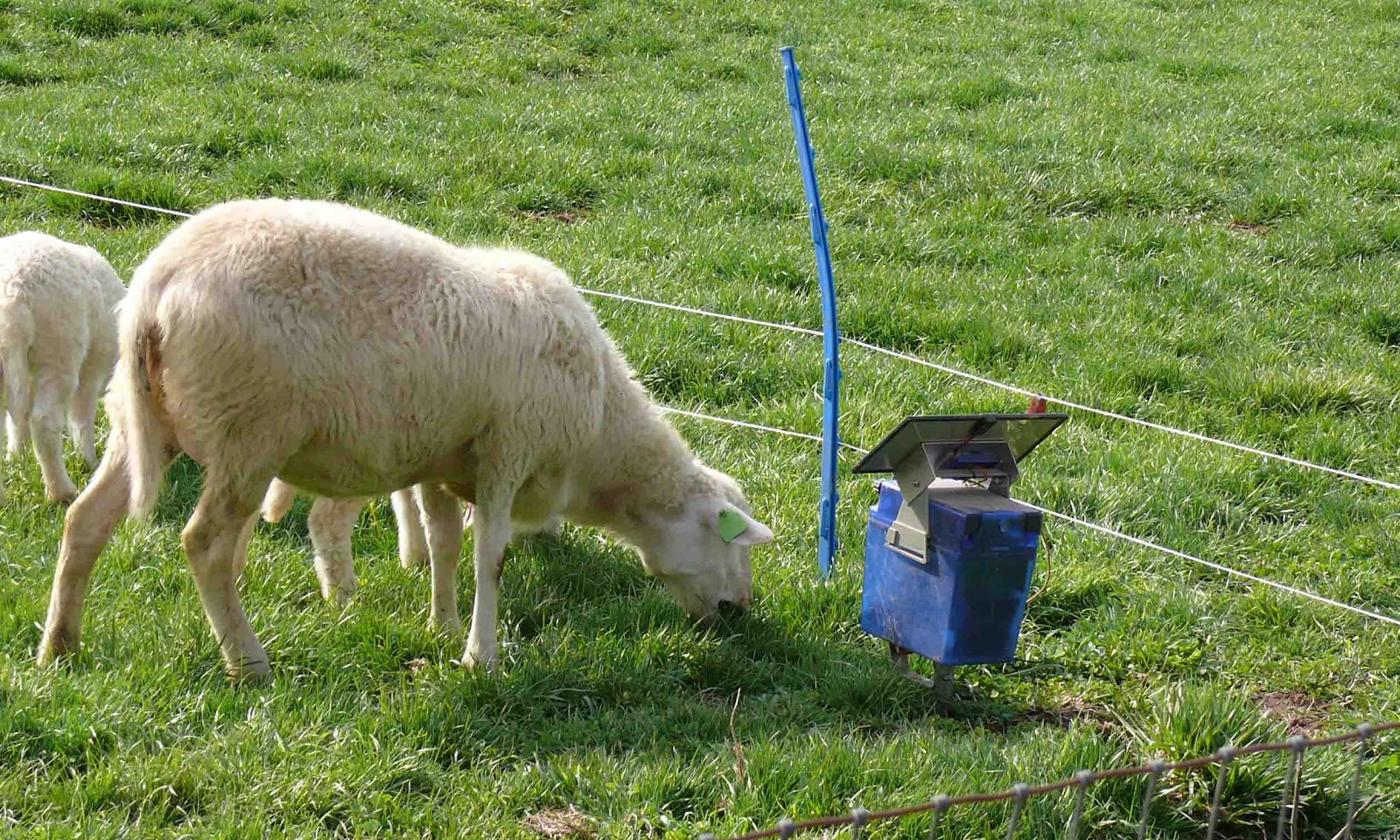
In order to mimic this pattern, we use a very handy set of tools including push-in stakes, polywire on a reel, and a electric charger. Most of our chargers are solar with a small battery attached for keeping the fence electrified at night. 

These tools allow the farmer to create small 'paddocks' for grazing across the property. This technique has been shown to actually increase the volume of forage from a given acreage of land and actually improve the pasture at the same time! Amazing!


Friday, December 14, 2012

Editor's note - excuse our very long absence. This is the first of more posts about farm life here on Whitmore Farm. This is from the perspective of one of our Fall interns Dave, who was kind enough to get the ball started. I thought people might like to hear what its like to show up here on the farm and just throw yourself into farm life without previous experience. NB: this is an unedited version ;) 

Dave the intern here, hailing from Brooklyn’s manic bustle for favor of a bucolic life, has blown the cobwebs from our blog to show just how far he’s come in his few weeks here. 

It’s important to note that I hadn’t spent one hour on a farm before my tenure here at Whitmore. 

As idyllic as the grounds and company are here, I had no frame of reference for what farming would bring. For example, the persistent thought pinballing around my head on my first night, October 2nd, was, “WHAT THE FUCK HAVE I DONE?!?!” 

When you adventure way out of your comfort zone, you often surprise yourself in ways you couldn’t otherwise fathom. 

I had left Brooklyn’s wild tapestry – its 24-hour delis, tireless hedonism, bad hipster moustaches – to sleep in a barn with no door, just a great open maw of space for creatures of all stripes to eat me alive – or so I thought. My mild arachnophobia turned acute, but it was all in my head: I soon understood that if I left them alone, they’d leave me alone. 

I also soon learned that both Will and Kent are incredibly welcoming, personable, smart as whips, and bangin' cooks. The three other fellows working here were as patient as Will and Kent watching my soft city hands try to navigate chicken nests. 

I already know that I will look back on these few months as one of the happier times of my life. Strange to be aware of that right in the midst of it. What a departure, what an arrival. What hosts! 

The chickens are no longer clucking and strutting animals of annoyance. They have it good here. I handle them without hesitation now, and welcome their birdsong (chickensong?) throughout the morning rounds where we feed and look after them.  

The goats still swarm like brain-mad zombies but only when you have something they can eat at hand. The pigs are playfully mischievous, as are some of the dogs, those six Great Pyrenees who seemed indistinguishable from one another that first week. 

I still fear the boars (hungry boars, to qualify it) but those fears have mostly evaporated. I’ve learned something new just about every day since I arrived, and faced many fears head-on. It goes to show: you can look through the eyes of fear or the eyes of love. 

As I never would have imagined being here and doing this, it’s fascinating to wonder just where I’ll be a couple months from now, well after I’ve left these kind grounds. Some lone vagabond strengthening without from within, lighting candles along the road. I can’t predict a fucking thing, and I certainly wouldn’t want to start.

Monday, June 13, 2011

It doesn't rain in the summer in Maryland anymore...

As we enter our 5 straight year of summer drought here in Maryland, every day I read about extreme weather all around the country and the world.

I wonder how people can still blindly deny that climate change (or global weirding as I like to call it) doesn't exist when the evidence is all around us? Of course, some of that is this misnomer of 'global warming' which oversimplifies the idea that global weather patterns will become more erratic and extreme.

All around us is news of extreme weather - tornados in Maryland and Massachusetts, flooding up and down the Mississipi River and droughts and wildfires in Texas and Arizona.

Of course for us, rain equals grass, which is what our ruminants eat. Without it, we end up having to feed hay.

This past spring, all we had was rain and more rain. But for the past month, we've had nothing but extremely high temps and no rain.

For the last 3 years, we've fed hay every July and August.

What that means of course is higher costs for us and our customers.

So far, this year looks no different than the previous four - a very wet winter and spring with bitter cold and heavy snowfall, followed by hot, very dry summer months.

This changes our business model into one where supplemental feed is require for 6 or more months out of the year - winter and summer.

Also, because our animals are coming out of a very dry summer season, they eat down the fall flush and we have no 'stockpiled' grass for early winter grazing.

As farmers, we watch the weather every day and right now, we're praying for rain!

We've had nothing but heat and dry weather for over 3 weeks now, the pastures are starting to brown, and the sheep and goats are hungry! I look forward to the months of July and August with a vague sense of dread :(

Friday, June 10, 2011

Organic certification

Recently, Will and I have been looking at our operation mercilessly to try and find a way to be profitable and more sustainable.

When I say sustainable, what I am specifically referring to is our sustainability as farmers in residence recognizing that the farmer is our most valuable asset. Too many long hours and hard work for little or no profit, and too many things we don't enjoy because they have nothing to do with farming.

One area that has dogged me since day one was our organic certification. Initially, more of an annoyance than anything else, I dutifully filled out the voluminous application each year and sent my $500 check in.

Considering that the whole 'organic' production model was the home of small producers (commonly less than 10 acres) from its birth in the 60's until about 10 years ago when it became a label regulated by the USDA (via the NOP = National Organic Program), I found the application to be incredibly annoying.

'Please record how many tons of each vegetable produced' was a pretty typical entry requirement.

'Just cross out ton and put in bushels', was the advice I gave our gardener Kyle when he asked what to do with a confused look.

Initially, our annual certification inspection involved a pleasant fellow, who would come by, look around a bit, ask some appropriate questions, and usually leave with the comment 'try and improve your record-keeping'.

Since then, there have been several well-known scandals involving large-scale producers caught cheating in their organic production.

Organic production has been increasingly annexed by the likes of WalMart and CISCO, who by their very business model, do not exemplify the ideals of organic production.

Large scale producers have gotten into the equation, trying to meet the demands of ridiculously low-prices and high production volumes of these kinds of retailers.

In response, the volume and voracity of NOP paperwork and oversight has skyrocketed, and Maryland has been no exception. The USDA regulates/sets the rules for organic production via the NOP, but the states are required for administering, regulating, and inspecting their own producers.

Our new inspector and program director for the entire state of Maryland, sort of embodies the very worst that one can associate with the words 'government bureaucrat'. Now don't get me wrong, he's a nice enough person I'm sure, but as an inspector and representative of the organic program in Maryland...well, not so much.

Very little money was provided to the states for the NOP program, despite all of the huge subsidies provided to commercial farming in this country, so there is no real motivation in seeing the success of organic production in Maryland as things currently stand.

The numbers tell the story - after the initial bump of certifications at the initiation of the program about 10 years ago, the numbers of organic producers continues to decline in Maryland even with the introduction of new producers.

In order to improve my quality of life, Will and I have decided to no longer bother with the organic certification process and focus our attention on something that no factory farm/large-scale producer can provide: high quality, locally-produced food for our customers.

Of course, we won't actually be doing anything differently than we currently do, but I figure we'll save several hundred hours of time spent filling out paperwork and ridiculous documentation to meet the NOP monster's insatiable appetite.

This is time I can spend with the animals, working in the garden, and visiting with customers, some of my favorite things!

Best,

Kent & Will