Monday, April 12, 2010

LARD - a love story


aka, LARD & human health.

What is lard?

Real Lard is rendered pork fat (also called tallow if it comes from a ruminant such as beef cattle).

Rendering is gently heating the fat to separate out the protein strands, the ‘cracklings’.

Real lard is a beautiful, white, naturally-partially-hydrogenated solid fat. Most of its carbon sites are filled with hydrogen in their natural and normal cis position just as it comes from the hog.

Good lard is only

• 40% SATURATED fat,
• 48% MONOUNSATURATED and
• 12% POLYUNSATURATED fat.

Lard is stable and is the preferred fat for frying because it does not easily turn into trans fats when heated. Foods fried in lard can therefore be cooked for a shorter time at a higher temperature resulting in a better taste, texture and less embedded oil.

Lard is a HEALTH FOOD that needs to be returned to its rightful place in the American diet!

There are two essential fatty acids (essential because our bodies cannot make them) and both are polyunsaturated, 18 carbon molecules. These are the OMEGA 3 and OMEGA 6 fatty acids, and there has been a lot in the media in recent years about them and their relation to human health.

OMEGA 6 is double unsaturated LINOLEIC acid and OMEGA 3 is the triple unsaturated LINOLENIC acid. The omega number refers to the location of the first double bond. Like other polyunsaturated fatty acids (PUFA’s) they are unstable, go rancid easily and should never be heated.

The healthful Omega 3 fats include:

1. CONJUGATED LINOLEIC ACID 9 conjugated linolenic acid (which is found in grass-fed animals especially ruminants).
2. DHA (the brain fat).
3. EPA which are found primarily in deep ocean fish.
4. GLA found in some plant oils.

Organically-raised, foraging, pasture-raised outdoor range hogs have the healthiest lard.

Commercially-raised, factory-farmed pork get virtually no exercise, live indoors (often in squalor) and eat no greens. Because of their diet, their lard is of equally low quality. The diet and lifestyle of the hog radically affects the quality of the lard! What a concept.


People always seem to be surprised by this, but I compare it to two humans, one of whom lives a livestyle as a couch potato, eating highly-processed, starchy foods and getting very little exercise and fresh air. In comparison, the second human is an exercise buff, who eats a diet rich in natural foods and spends much of his/her time out-of-doors. How do you think these two humans would fair in terms of their cholesterol levels and fat to meat ratio?

Confinement pork lard has similar OMEGA 6:3 ratios to feedlot beef with a 100gm serving containing about 8 grams of Omega-6 and 0.8 grams of Omega-3. That works out to a ratio of 10 to 1!

A much more healthful ratio of O-6:O-3 can be achieved by increasing the amount of fresh green forages. The O-3 content can be greatly enhanced by feeding flax seed, sea greens, green algae or fish oils but simply putting animals back on pasture can profoundly change their omega fatty acid to something approaching the quality of fish oils!

It should come as no surprise that hogs fed garbage will incorporate all the toxic trans fats, heavy metals or other toxins into their fat. By-products of commercial, processed food operations (think potato ship crumbs from the factory floor) are often touted as a ‘great source’ of cheap feed for hogs and even ruminants like sheep.

Over the past 100 years, the rates of heart disease and atherosclerosis have climbed significantly despite our move away from ‘bad fats’ like lard to ‘healthier’ fats like margarine. This despite the fact that our traditional diet contained high levels of fat (lard) and we had low-rates of heart disease. This has been further supported by the paradox of French cooking which combined high-levels of animal and other traditional fats with low-rates of heart disease.

Meanwhile, the health of Americans plummeted as dieticians recommended vegetable oils for cooking, especially partially-hydrogenated oils.

Shortening, for example, is a liquid oil until manufacturers heat it up under pressure and bubble hydrogen gas into it ! Can you imagine!!

Why do they do this you might ask? Because hydrogen added in the trans configuration increases shelf life of the oil and allows vegetable oils and corn oil not to go rancid in large, clear containers exposed to light and heat on the store shelves.

A lot of hydrogen added in the trans configuration solidifies the liquid oil, creating stick margarine or solid vegetable shortening, such as Crisco.

Polyunsaturated oils go rancid easily due to unstable double bonds.

Fats are made of FATTY ACIDS which are carbon-hydrogen chains (C-C-C-C-C-C-C-C-C-C) that latch on in groups of three to a glycerol backbone to make a TRIGLYCERIDE molecule, which are the basic molecules of which all fats are made. The length of the carbon chains and where, if any, double bonds (i.e. missing hydrogen molecules) occur differentiate the fatty acids one from another.

The more double bonds, the more unsaturated. One double bond gives you monounsaturated, many double bonds gives you a polyunsaturated, and no double bonds gives you a saturated fatty acid.

The main saturated fatty acids (from shortest to longest chains):

1. CAPRIC
2. LAURIC
3. MYRISTIC
4. PALMITIC
5. STERIC acids.

The main monounsaturated is OLEIC acid.

Olive oil contains 71% OLEIC acid and is heart-healthy, monounsaturated fat that we’re supposed to get more of.

Lard contains 44 % oleic acid, sesame oil (41%), corn oil (28%), walnut oil (28%), flaxseed oil (21%), cottonseed oil (19%) and sunflower oil (19%), grapeseed oil (15%) and safflower oil (13%), beef tallow (43%), butterfat (29%) and human butterfat (ie the fat of breast milk at 35%).

Like olive oil, lard contains 10% of the omega-6 fatty acid LINOLEIC acid, again, roughly the same as human butterfat (breast milk) at 9%.

1. Lard also contains 14%) of the 18-C saturated fat STEARIC acid, which has been shown in clinical testing to lower cholesterol.

2. Lard contains 2% MYRISTIC acid, a 14-C saturated fat that has been shown to have immune enhancing properties. Human butterfat is 8% myristic acid, cottonseed oil (1%) and the tropical vegetable oils (coconut oil and palm kernel) have zero.

3. Lard contains 26% PALMITIC acid (a 16-C saturated fatty acid) olive oil only 13%, and human butterfat contains 25%. Palmitic acid is antimicrobial.

So Lard’s basic fatty acid composition is comparable to the butterfat of human breast milk, with even less saturated and more monounsaturated fatty acids.

Breast Milk

Saturated 48%
Monounsaturated 35%
Polyunsaturated 10%

Lard

Saturated 42%
Monounsaturated 44%
Polyunsaturated 10%


Our bodies need saturated fats.

• Saturated fats make up over half of all cell membranes and give cell membranes stiffness and integrity.
• Bones require about 50% of the dietary fat to be saturated so calcium can be absorbed.
• Saturated fats lowers Lipoprotein-a in the bloodstream, an inflammatory marker directly associated with the risk of heart disease.
• Saturated fat protects the liver from alcohol, toxins and drugs and they enhance the immune system.

Omega 3 fats are retained in the tissue when the diet is rich in healthy saturated fats. Heart muscle contains rich deposits of stearic acid and palmitic fatty acids as energy sources during times of stress.

Many saturated fats have antimicrobial properties and protect us from harmful pathogens in the intestine.

There is no good scientific evidence to back up claims that saturated fat causes clogging of arteries per se.

In fact arterial plaque is only 26% saturated fat – the other 50+ % being polyunsaturated fat!

Our bodies need some cholesterol and it is only found in animal fat.

Cholesterol makes up a large portion of brain tissue and is the building block of all corticosteroids and hormones in the body, and is a precursor to vitamin D.

Cholesterol keeps our skin soft and moist, and makes the bile which we need to digest fat.

Human breast milk is very high in it.

Our bodies make over 2000mg of cholesterol daily whereas a maximum of only 100mg can be absorbed from the diet.

Cholesterol is required for proper function of serotonin (the ‘feel good’ brain chemical) such that low cholesterol levels are associated with aggression, violence, depression and suicidal tendencies.

TRANS FATS are one of the most dangerous foods in the world. They serve no purpose in the body except to cause inflammation, cancer and degenerative disease.

Trans Fats began to enter the diet of Americans in the early 20th Century which coincided with a new problem of heart disease in America. Nowadays, most Americans consume up to or more than 20% of their fat intake as trans fats.

Tranfats cross the placenta and are incorporated into fetal tissue, even the brain. Cell membranes are a bi-layer (two-sided) of fat with a thin protein coating on both sides.

Some people feel that if Trans Fats gets are incorporated into cell membranes, they become defective and won’t resist infection and are more cancer prone.

Trans Fats may cause problems in the brain as DHA or other brain fats cannot be made from it, and the stiff and straight abnormal molecule creates overly rigid membranes.

Consequently, some people feel there may be an association between a diet in Trans Fats and the incidence and clinical course of brain disease like MS, ALS, Alzheimers, Parkinsons and maybe even depression, schizophrenia, and other mental illnesses.

Lard can be obtained from any part of the pig as long as there is a high concentration of fatty tissue.

The highest grade of lard, known as leaf lard, is obtained from the "flare" visceral fat deposit surrounding the kidneys and inside the loin. Leaf lard has little pork flavor, making it ideal for use in baked goods, where it is treasured for its ability to produce flaky, moist pie crusts.

The next highest grade of lard is obtained from fatback, the hard subcutaneous fat between the back skin and muscle of the pig.

The lowest grade (for purposes of rendering into lard) is obtained from the soft caul fat surrounding digestive organs (the omentum), such as small intestines. Caul fat is often used directly as a wrapping for roasting lean meats or in the manufacture of pâtés.

Lard in history and its use in food.

Lard has always been an important cooking and baking staple in cultures where pork is an important dietary item, the fat of pigs often being as valuable a product as their meat. Obviously, it is also prohibited by dietary laws that forbid the consumption of pork, such as kashrut and halal.

During the 19th and first-half of the 20th Centuries, lard was used in a similar fashion as butter in North America.

As a readily available by-product of modern pork production, lard was previously cheaper than most vegetable oils, and it was common in many people's diet. During the industrial revolution, new techniques were developed for the production of vegetable oils and they became more common and more affordable.

NB: Bear in mind, this would have been for the first time in human history!

Vegetable shortenings were developed in the early 1900s, which made it possible to use vegetable-based fats in baking and in other uses where solid fats were called for.

Toward the late 20th century, lard began to be regarded as less healthy than vegetable oils (such as olive and sunflower oil) because of its high saturated fatty acid and cholesterol content.

NB: Despite its reputation, lard has less saturated fat, more unsaturated fat, and less cholesterol than an equal amount of butter by weight.

Unlike many margarines and vegetable shortenings, lard contains no trans fat.

Lard’s lost popularity as it became viewed old-fashioned, unhealthy, and something poor people ate.

Many restaurants in the western nations eliminated the use of lard in their kitchens because of the religious and health-related dietary restrictions many of their customers demanded in an effort to ‘eat healthy’.

Many industrial bakers began substituting corn-fed beef tallow for lard in order to compensate for the lack of mouthfeel in many baked goods and free their food products from pork-based dietary restrictions.

Luckily, following this disasterous switch to high-trans and hydrogenated fats in the 1960’s and 70’s, the unique culinary properties of lard were rediscovered (never having been forgotten by French chefs) leading to a partial rehabilitation of this fat among "foodies" and chefs in this country. This trend has been partially driven by negative publicity about the trans fat content of the partially hydrogenated vegetable oils and in vegetable shortening.

It is also again becoming popular in many countries as people have explored and rediscovered the virtues of traditional cuisine over modern ‘healthy food’.

Lard is one of the few edible oils with a relatively high smoke point, attributable to its high saturated fatty acids content. Pure lard is especially useful for cooking since it produces little smoke when heated and has a distinct taste when combined with other foods. Many chefs and bakers deem lard a superior cooking fat or shortening because of lard's wide range of applications and taste.

Because of the relatively large fat globules found in lard, it is extremely effective as a shortening in baking. Pie crusts made with lard tend to be more flaky than those made with butter.

Lard was once widely used in the cuisines of Europe, China, and the New World and still plays a significant role in British, Central European, Mexican, and Chinese cuisines.

Lard consumed as a spread on bread was once very common, especially those areas where dairy fats and vegetable oils were rare. A slice of bread spread with lard was a typical staple in traditional rural cuisine of many countries.

As the demand for lard grows, many small farmers have begun to specialize in heritage hog breeds with higher body fat contents than the leaner, modern hog. These were the traditional ‘lard pigs’ of history that were raised just as much for their valuable lard as for their wonderful, flavorful meats.

http://lardlovers.ning.com/

www.westonaprice.org

www.eatwild.com


Saturday, April 10, 2010

The British are Coming! The British are Coming!

Well, British hogs that is...and well, they've already arrived!

Do you think it would to obvious to call her 'spot'?
The Gloucester Old Spot Hogs have arrived at Whitmore Farm!

Thanks to Rich Tilyou, a breeder and real champion of this rare English breed of hog for providing us with breeding stock for what we hope to be the epicenter of rare breed hog-dom in Maryland.

Check out Rich's home page featuring his excellent Tamworth and Gloucester Old Spots (from hereon to be referred to as GOS's) at http://www.heritagebreedsusa.com/TMeadow.html

Commonly called the orchard pig, they were often finished on fallen fruit and other agricultural byproducts like whey. Old-time farm stories from Britain describe their black spots as bruises from falling apples.

The breed originated around the Berkeley Vale in Southwest of England and is thought to have been derived from the original Gloucestershire pig (a large white pig with wattles) and the unimproved berkshire (a sandy colored, prick-eared pig with spots), both of which forms are extinct at present.

Old Spots are hardy and do well on pasture, are known to have an easy disposition, and at one time, came close to extinction. The breed hit its high point in popularity in Great Britain just after World War I when its lean meat was preferred.

This is how we raise our pork...on pasture as nature intended it! Here we have our herefords from December and our new stock of GOS's.

Old Spots continued as the pork of choice for discerning pork-ophiles and in livestock shows throughout the 1920’s and early 1930’s. However, after World War II, the breed became increasingly rare with a shift to intensive pig production and reduced interest in pigs that could thrive out of doors. The remaining population nearly became extinct in the 1960s, though it has been increasing slowly since then, thanks to the work of people like Mr. Tilyou. Even now, the genetic pool is quite shallow especially in the United States and breeders in this country look to introduce new genetics from the U.K.

Gloucestershire Old Spots pigs were first imported to the United States during the 1900s, and they made genetic contributions to several American breeds, including the American Spot and the Chester White. The breed never became numerous in the United States, however, and was practically extinct by the 1990s when twenty Gloucestershire piglets were imported to reestablish a purebred population in America. A breed society was founded, and the number of animals in the United States is increasing.

As of 2009, there are less than 1000 Gloucestershire Old Spots in Great Britain and fewer than 200 breeding animals in the US. The breed notably benefits from continued support of the British Royal Family who favors pork from these pigs for their table.

The Gloucestershire Old Spot pig is known for its docility, intelligence, and prolificacy. Boars reach a mature weight of 300 lbs (136 kg) and sows 275 lbs (125 kg). The pigs are white with clearly defined black (not blue) spots. There must be at least one spot on the body to be accepted in the registry. The breed’s maternal skills make it able to raise large litters of piglets on pasture. Its easy disposition and self‑sufficiency make it an attractive hog for small farmers raising pigs on pasture.


The pigs are so darn friendly...its impossible to get a good picture! They love to be scratched and talked to...

The Gloucester Old Spot is listed as critical by the American Livestock Breeding Conservancy, an organization dedicated to the preservation of rare breed livestock animals.

http://albc-usa.org/

As with many other areas of the world economy, the consolidation and industrialization of agriculture has led to a move towards monocultures of livestock. This has proven to be disastrous for traditional and landrace varieties of livestock, many of which developed over many centuries and created unique qualities, disease resistance, or traits that are not easily recreated if lost.

Much as with wild animals, the ALBC and heritage livestock breeders work to protect these unique lines of animals from extinction. That is one of our goals at Whitmore Farm in breeding rare breeds and educating farmers as to the many advantages they have over industrial stock.

Oftentimes, the ONLY disadvantage they have over commercial livestock is they don't perform well in confinement, cages, and other unhealthy environments that have become the norm for factory farms.

This is how we raise our animals...fresh air, sunshine, shade on hot days and a natural wallow. The wallow (a mudpuddle) allows the pigs to coat themselves with mud which protects them from biting flies and a sunburn.

What the heritage breeds DO typically excel at are traits like:

1. Extreme hardiness to cold, bad weather and other adverse conditions.

2. Good natural resistance to disease.

3. Strong maternal traits.

4. Calm disposition making them easy to work with.

5. Excellent flavor.

6. Good feed conversion on pasture and an ability to survive on relatively 'thin' rations (i.e. poor quality grass for example).

7. A sense of what the French call terroir, where unique foods come from unique places. Think of the vidalia onion or a coney island hot dog.

This sense of terroir is one of the things that make foods exciting and interesting. We are happy to be working to protect this breed in the United States and look forward to offering our customers a 'bit of Old Spot' pork in 2011 and onwards.

One of our areas of interest is smoking and curing our own meats. We are currently working to perfect our first year of Maryland proscuitto!

It is a beautiful sight to see animals on pasture!


Saturday, March 27, 2010

Farmers Markets, eggs and The Common Market


Well, we've been trying to figure out where our retail outlets should be this summer and a plan has slowly come into view for 2010.


As it stands, we will be attending two markets this year, both on Saturday morning:

Fresh Farm Bethesda Market
June 19 - Oct 30, Saturdays, 9-1:00.
Norfolk Ave. at Veteran's Park.

Burleith/Glover Park Market,
May 8th - Oct 30th. Saturdays, 9-1:00.
Wisconsin at 34th Street, NW (across from the 'social Safeway')
Hardy Middle School parking lot.


(We are sad to be leaving our spot on Wednesday's in Rose Park:(

Thanks to the new program launched by the Maryland Dep't of Agriculture, we will be able to legally sell farm-fresh poultry and rabbit at the Bethesda Market.


We have ordered our broiler chicks and will be pasturing them starting in April for 2 batches of chicken sales this summer!

There is some hope that the USDA may change rules in place that currently only allow the sale of meat crossing state lines to come from a USDA-inspected abbatoir (meat processor).

If the new rules are passed, they may allow state-inspected facilities that meet the same standards as USDA-inspected facilities to be sold across state lines (think Maryland to D.C. farmers' markets).

As a farmer, I can attest that the presence of state, USDA or any other kind of certification really does not mean that much in terms of food safety.

For example, there have been several closures of large kosher USDA-inspected processing centers in the midwest in the past several years for serious infractions. These were situations where the kosher certifier may have looked the other way and allowed things to pass that were SO BAD that even the USDA intervened.


In the end, knowing who raises your food, under what conditions, and trusting in your farmer to work with reputable and humane butchers is the BEST way to be confident in the meat you are getting.

We also hope to supply more of our products to The Common Market ( a wonderful food COOP in Frederick and our grocer of choice in Frederick) and VOLT Restaurant (also in Frederick) http://www.voltrestaurant.com/

We are excited to see one more barrier to direct-to-consumer sales fall!

See you at the markets!

K

Wednesday, March 24, 2010

As a consumer, what can I do?

Oftentimes, our customers will ask in frustration what they can do to help change our seriously warped industrial agriculture system. It can be overwhelming because its become such a big problem. It can be hard to know where to start.

The good news is there is a lot than can be done and it all begins at the beginning! Many changes begin in small ways and are easily implemented even when working hard as a busy parent, homemaker or worker bee.

First of all, every time you buy something locally produced at a farmers' market or local coop, your dollars are making a statement, sending a message to producers, and removing one animal from an inhumane feedlot operation.

This is probably the one most important thing you can do and has a profound and rippling affect down throughout the ag system.

By supporting producers doing the right thing, you strengthen them and make it easier for them to compete, increase their production and continue to spread the good word.


Which leads me to my next item, which is education. I consider this probably the most important thing because every time I can get someone thinking about food and its provenance, I create a lifelong catalyst for change. There are too many people who are ignorant and blissful.

Now don't get me wrong, I love a little ignorant bliss as much as the next person, but some things are too important to ignore. Food and its provenance is one of those things. The costs are just too high for our health, the health of the environment, our local farming community and the misuse of public funds (i.e. your money) to support a pathologic system of food production.

When you buy food from retailers like BJ's or COSTCO, you directly support the mistreatment of animals, the ruining of our physical environment, the exploitation of workers in very powerless situations, and serious effects on human health.

As a parent, are you concerned about your family's well-being? What are the long-term ramifications of your spending habits. What about your children's lives? Are your habits making the world a better place for them when they reach adulthood and are looking to have their own families?

If you're a religious person, should you treat the world around you as a treasure or something to be exploited, used up and then discarded? Animals, plants and the world we live in deserve to be treated with respect and kindness.

I've heard that American Indian traditions require that any new practice be judged as to its affect several generations or more down the line, before they are considered just or permissable.

Just because the Chinese are willing to make the same mistakes we made in terms of their environmental protection doesn't mean we shouldn't care or that we should support their bad decisions just because its cheap. Much of what we eat is now coming out of China and other essentially unregulated sources.

We now have melamine in our food supply in THIS country because of our careless policies that emphasize cheap food above all else. And dust storms now blow across the continents from Africa and Asia and significantly (and usually negatively) affect weather in North America.

Okay, enough preaching. Sorry but this is something I feel just can't wait. I am most certainly an idealist at heart.

Here are some very concrete suggestions you might want to explore:

1. Join a CSA.


This is a great way to get hooked up to the local food production community and get the freshest, best things that local farmers have to offer. Not all CSA's are the same and you should look around for a CSA that best suits your needs in terms of delivery, the kinds of products included (just veggies, milk products, meats, year-round, costs, etc).

I think we may be launching our first CSA's next fall and will target Frederick, Maryland for easy delivery. Hopefully, we can expand to D.C. if all goes as planned in 2010.

2. Check out some really great films out now and consider showing them locally:


3. Frequent your local farmers' markets, get to know your farmers and talk to them. Ask them about barriers to delivering their products to market.

Oftentimes, there are simple things that can be done to remove barriers to local food delivery. A good example here in Maryland were existing state laws that prevented farmers from selling poultry processed on-farm to consumers at farmers' markets. We could sell you a chicken on the farm, but not at the local farmers' market.

Arbitrary and unnecessary legislation harking back to a time when off-farm poultry processing was readily available to local farmers. This is no longer the case as small abbatoirs have struggled to compete with super cheap meats.

Maryland Dep't of Ag recently created a new program to certify farmers to process their own poultry for resale to consumers at farmers' markets directly. This still doesn't solve the problem of other retail outlets unavailable to local farmers, like your family supermarket, but we often measure change in small steps.

4. Explore some online resources specifically geared towards connecting consumers with local producers. Many have email alerts that can help you keep current on legislation affecting the local foods movement in your area.

Here are just a few:


Future Harvest/CASA - the Chesapeake/Maryland chapter for sustainable agriculture

SLOW food USA - awesome global organization that promotes local food. They have a yearly conference in Italy every year! Italy anyone!

LOCAL HARVEST - good resource for finding local producers and local farming/consumer events.

Farm-to-Consumer Legal Defense Fund http://www.ftcldf.org/ - helps counteract some of the unfair practices affecting small producers and their access to consumers. helps counteract some of the oppressive bureaucratic oversight and powerful big-ag lobby.

EAT WILD! - a good resource for finding grass-fed, finished operations in your area. grass fed meats have been shown to have the same health benefits as fish oil in terms of high levels of omega-3 fatty acids.

100 mile diet Try eating only locally produced (within 100 miles) food for a month or a year. Don't worry, you're allowed a few luxury items like coffee, tea, OJ, etc!

I'll stop there but this is just a beginning! Please don't be offended by what I have to say - this is my opinion. Educate yourself and then get back to me as to whether I was off-base or not ;)

A word of warning however...this is a slippery slope. Once you start to educate yourself, you can't easily turn back to that blissful place and you will never look at what and how you eat the same way again :)

K

Friday, March 5, 2010

Lambs, lambs everywhere!

Well, after last week's kidding by Lucy, we have finally concluded our first (and last! lol) February lambing.


Granted, who could have predicted the worst weather in recorded history and all in all, we did pretty well despite the weather. This was our first try at winter lambing and it was not completely satisfactory.

The advantages of lambing on pasture, our normal practice, were clear pretty quickly. Aside from the obvious issues about cold weather, we kind of overlooked the difficulties of keeping a clean environment with so many animals on the barnyard.

Without good hygiene, enterocolitis and coccidia become major problems and treatment can be difficult, time-consuming, and somewhat unsatisfactory.

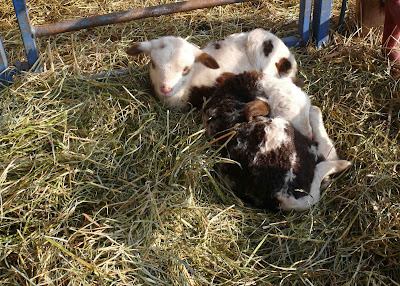
Here are some of our bottle babies during feeding time. We took a more aggressive stance and culled several mom's with non-functioning teats and other irreparable problems.

Lambing on pasture allows you to take advantage of the natural cleaning properties of wind, sun and rain. The mother's segregate themselves to find a quiet corner to lamb in.

Given the fact that katahdins are such good mothers and easy lambing predominates, assisted deliveries are rare. the biggest problem we've had is new mom's confusing lambs born at about the same time and highly hormonal expectant mom's stealing other's lambs! lol


We lost 2 lambs to cold and one lamb to a pneumonia, but the remaining 125 are doing beautifully!

We also had 4 malpresentations, one retained lamb, 4 mummies, 4 cases mastitis, one set of quads, one set of septuplets, and one emergency c-section.

I'm not entirely sure but believe that our c-section dame may have ruptured her uterus plus or minus a placenta previa. Her two lambs are doing fine on the bottle and I expect to retain both for our genetics.


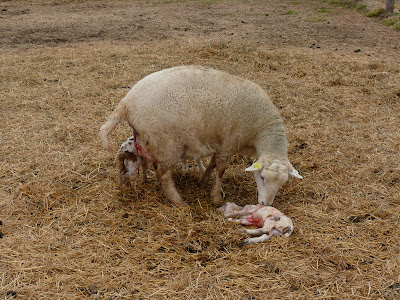
Here's a sequence that illustrates nicely the normal progression of lambing:

This ewe has already delivered her first lamb when I arrived. Note the fresh umbilical cord hanging below her lamb.


The dame continues to paw the ground in a nesting maneuvers while she smells and explores her lamb, cleaning it quickly by licking it dry. This cleans up the scents of blood that might draw a predator and dries the lamb who can chill very quickly.

The lamb will quickly struggle to its feet and start searching for the teat. It is vital that it find the teat quickly in order to get as much colostrum as possible.

Colostrum is like lamb jet fuel, very high in calories, fat and energy, as well as vital antibodies to shore up the lambs non-existant immune system. Without colostrum, the lamb is MUCH more likely to perish from cold, pneumonia and starvation.


The lamb has found the teat and her nursing action stimulates prolactin release in the brain which encourages milk let-down and stimulates more uterine contractions. Suddenly the ewe is back in labor and is gearing up for her next lamb.


The ewe lays down, pushes out another lamb and then quickly gets up, turns and starts cleaning and stimulating her second lamb. If this happens too quickly after her first lamb is born, one lamb may not get the attention it needs.

Sometimes, the amniotic sac is covering the new lamb's airway and without mom's help, the young lamb may not be able to break free on its own.


With the second lamb nursing, mom's contractions are really kicking in and she quickly has the urge to push once again. The process repeats itself for a third time and she is done. The afterbirth will follow within a few hours and the best mother's eat the placenta to clean the birth site and as a valuable nutritional addition. Her body condition will deteriorate rapidly over the next 10 weeks as she nurses 3 lambs and she needs every calorie, all the iron and protein she can get.

~K

HOOP houses and the USDA

I've been thinking of some ideas on what to write about lately and decided to give kudos to the USDA who has finally come up with a program that will encourage local, sustainable agriculture.

They have recently created a reimbursement program to defray costs to small producers who want to build a hoop house, otherwise known as a cold frame or french-style cold greenhouse.

This is actually an old technique where two layers of air are used to hold heat in in order to raise cool season veggies in the winter and extend the warm season further into spring and fall for heat-loving plants like tomatoes.


Remember, there was a time when fresh produce could not be shipped across country during winter months, and people relied on squash and canned goods to get their veggies in the winter. This was one way to allow fresh, seasonal greens for example to be produced in northern climes.


While the money is limited, it does give small producers an opportunity to grow product in the winter months for local resale.

We are very excited to join this awesome program and look forward to offering fresh produce essentially year-round to our customers.